How a person walks, stands, and balances is one of the clearest signals of how well they are doing overall. functionIQ turns a few short, evidence-based tests into a picture of what is changing, so seniors, their families, and the teams who care for them can act early instead of reacting late.
Talk to us → See how it worksThe same measurements answer a different question depending on who is asking. Choose the one that sounds like you.
Walking a little slower. Pushing off the armrests to stand. Taking the stairs one at a time. Each on its own means nothing. Together, over months, they are the clearest warning we have, and almost nobody is measuring them.
There is nothing to wear, nothing to install at home, and nothing for the older adult to prepare. A qualified clinician runs the same brief set of tests each visit, which is exactly what makes change visible.
A clinician measures walking speed, how easily someone rises from a chair, balance, and general mobility. Under ten minutes, wherever the person already is.
Numbers become sentences. Where this person stands today, what it means practically, and what would help most.
Measurement alone changes nothing. Results route into exercise, rehabilitation, or a change in support, which is the part that is proven to work.
The same tests, repeated on a schedule. Now there is a trend, and the trend is the thing nobody else has.
Four validated measures used in geriatric practice worldwide. Each one has published research behind it linking performance to real outcomes in older adults.
Executive directors, wellness managers, and recreation teams all face the same gap: staff can sense that a resident is slipping, but there is no objective way to show it, act on it, or prove that the programming is working. functionIQ closes that gap without adding to your team’s workload.
| Typical rehab partnership | functionIQ program |
|---|---|
| Triggered by an incident or a referral | Runs continuously, on a schedule |
| Treats people who are already declining | Identifies people who are starting to decline |
| Notes go into a chart and are rarely re-read | Trends are visible at a glance |
| Family updates are anecdotal | Family updates are grounded in measurements |
| No view above the individual resident | Community-level picture for leadership |
When someone you love is getting older, the hardest question is usually the one nobody says out loud: are they actually okay, or are small things slowly getting harder? Most families are left guessing between visits, reading into a phone call, or waiting for something to go wrong before anyone acts.
Most tools aimed at older adults lead with risk, decline, and everything that might go wrong. That framing is both unpleasant and unhelpful. The reason to measure how you move is far simpler: it is the most reliable way to keep doing the things you want to keep doing.
Because the alternative is finding out the hard way. Most people do not notice their walking has slowed or their legs have weakened until something happens that is difficult to come back from.
Measured early, most of it is workable. Exercise remains one of the best-supported interventions in all of medicine for maintaining strength and reducing falls in older adults. Measurement is simply how you find out what to work on, and how you confirm that it is working.
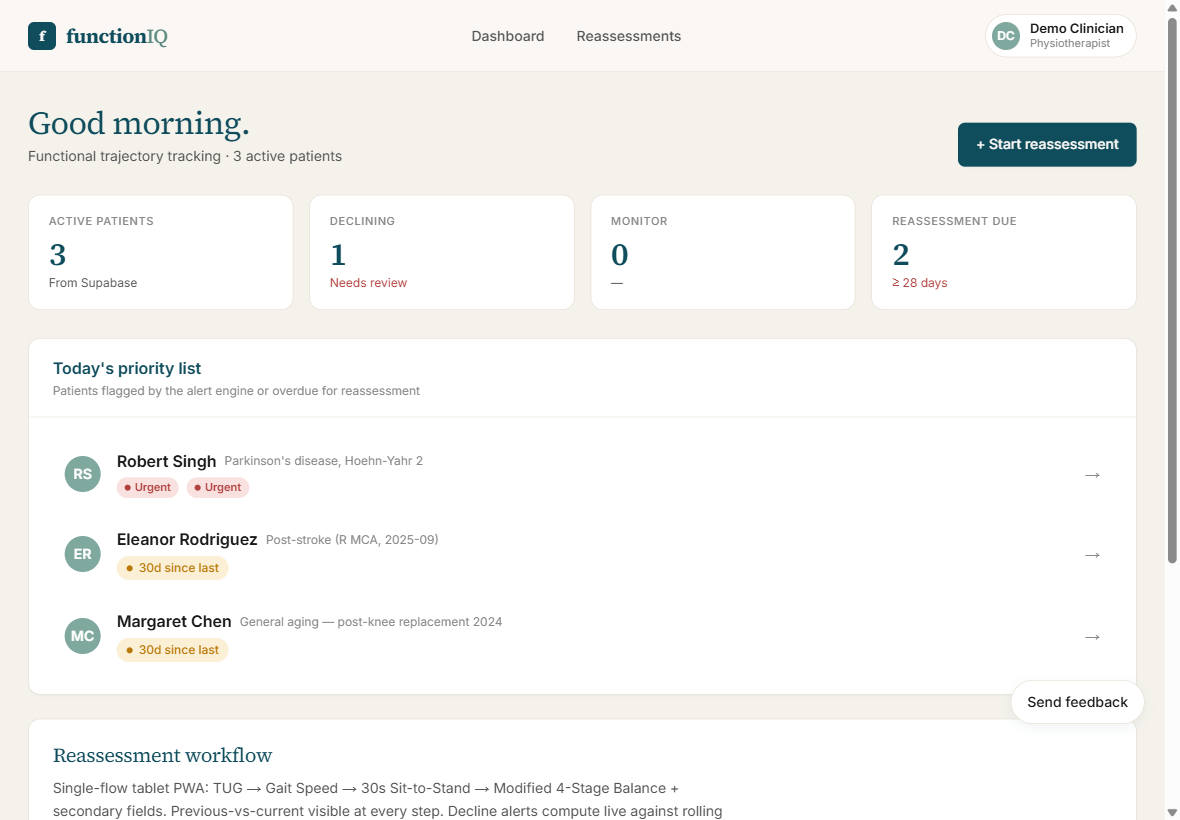
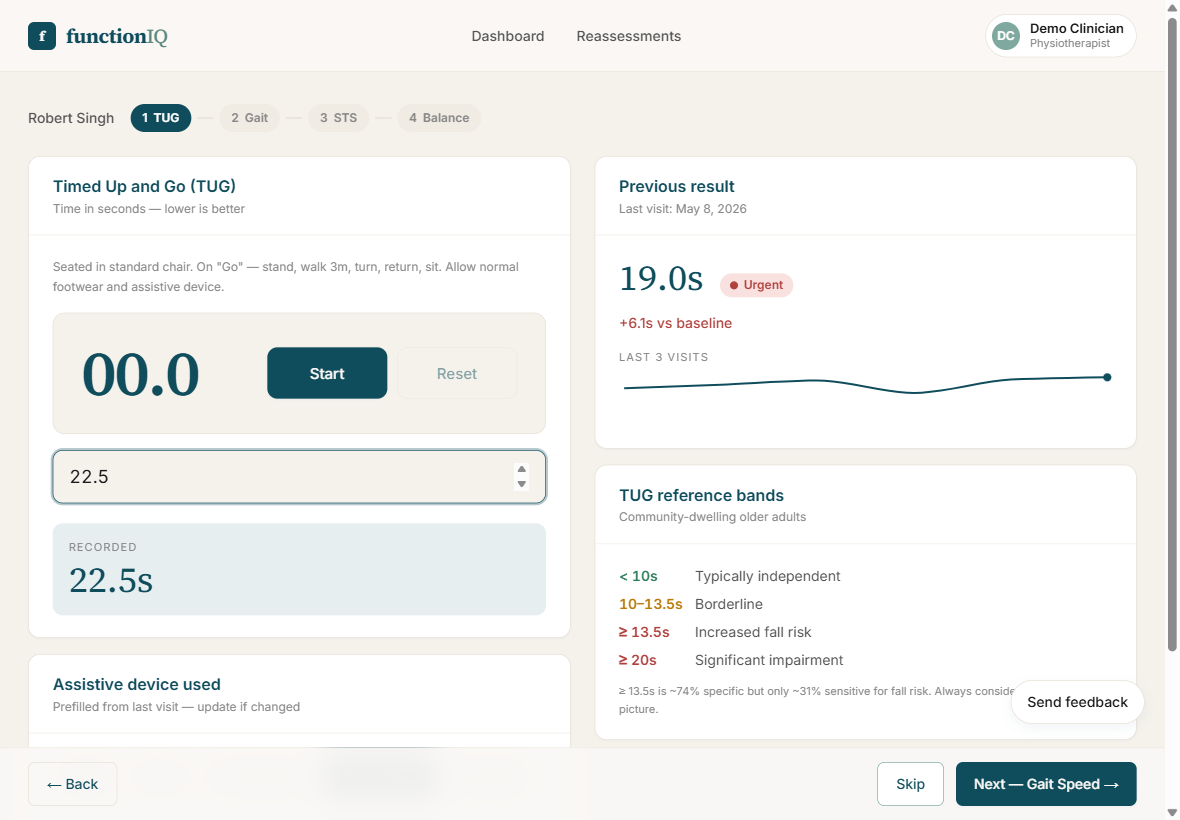
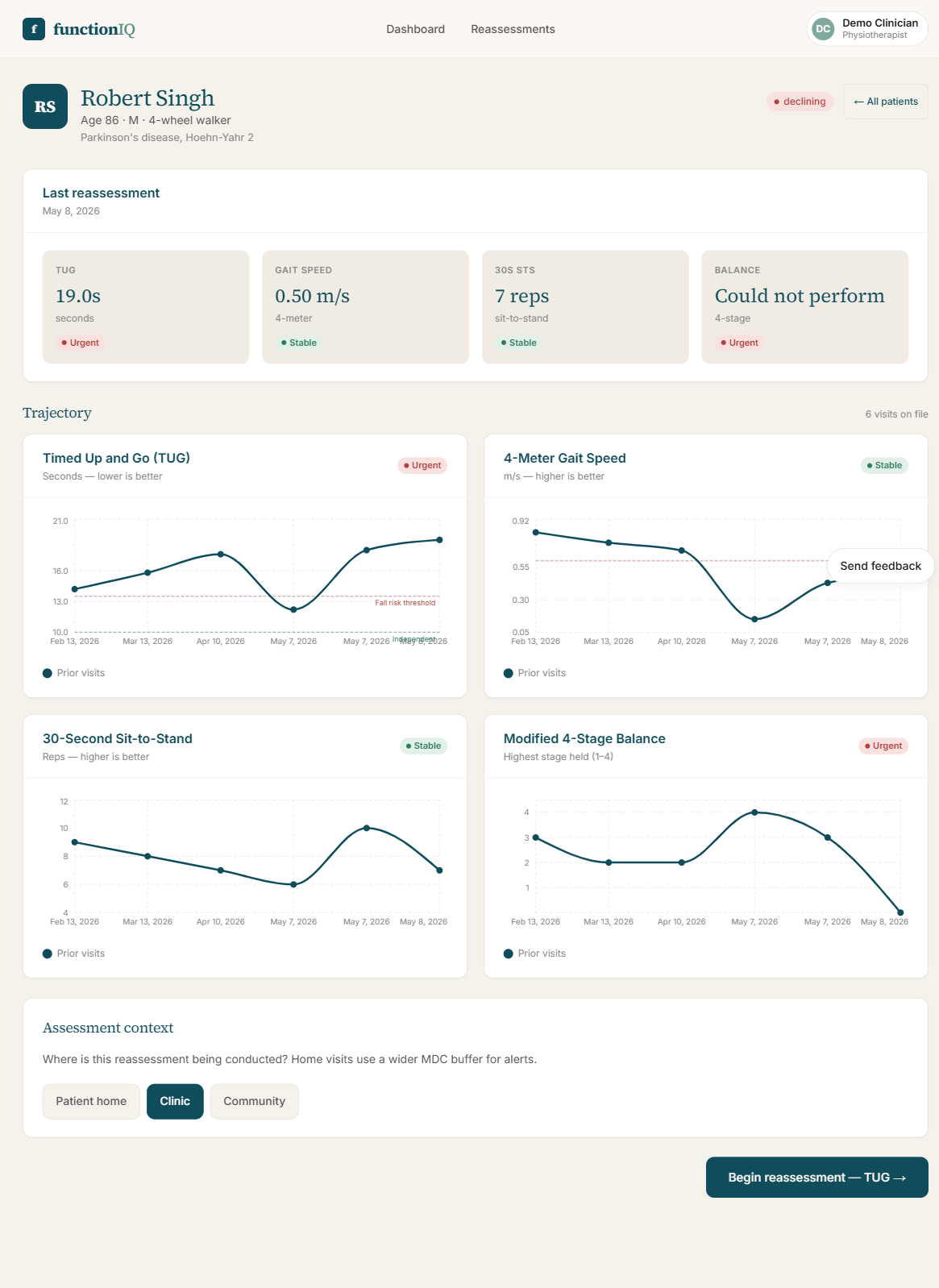
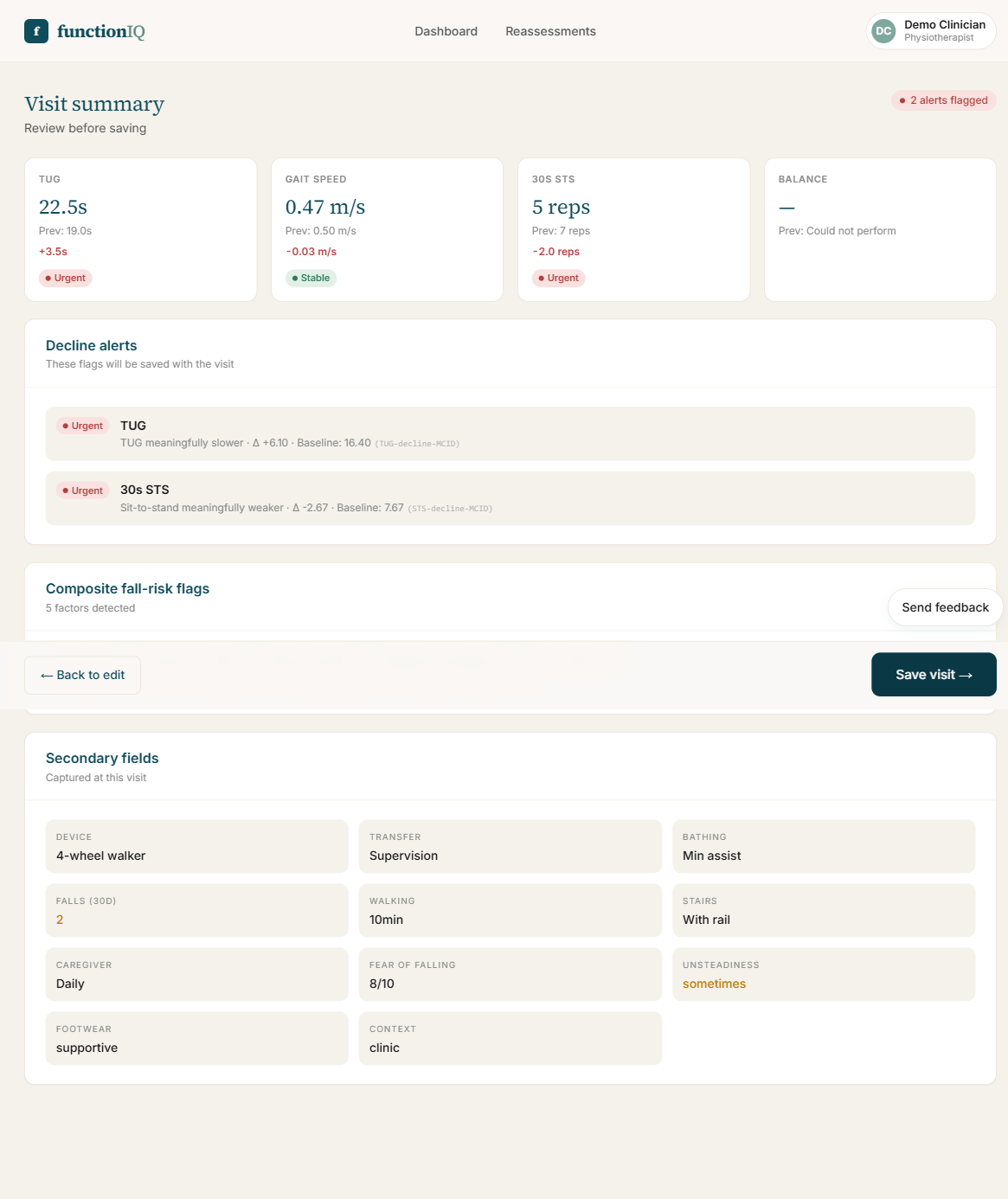
Behind the plain-language summaries is software that clinicians use during real visits. Below are screenshots from the live platform.
functionIQ is not a US product retrofitted for Canada. It was designed here, for Canadian privacy law, from the first line of code.
All personal health information is stored on Canadian infrastructure, not exported abroad.
Role-based permissions, isolation between organizations, and an audit record built into the data model.
Flags come from explicit, documented rules a clinician can inspect and challenge. Nothing is generated by a language model.
Runs on a tablet and keeps working when the WiFi does not, syncing once it reconnects. Home visits demand it.
functionIQ was built by a working clinician. Nicolas runs PhysioHome, a home-visit physiotherapy practice across Vancouver’s Lower Mainland, and the problem functionIQ addresses is one he encounters weekly: knowing that a client is losing ground, and having no structured way to show it, act on it, or track whether the plan is working.
PhysioHome is where functionIQ runs today. Every part of the platform has been shaped by real visits with real older adults, in their own homes, under real time pressure. That is also why speed matters so much in the design: an assessment that takes too long simply stops being done.
We are now opening conversations with senior living communities, activity centres, and home-care providers across the Lower Mainland who want to bring the same approach to the people they serve.
Whether you run a residence, coordinate a seniors’ program, lead a care team, or are simply trying to work out what your parent needs, the next step is the same: a short conversation. No obligation and no pressure, and if functionIQ is not the right fit we will say so.
Email Nicolas → Clinicians: request access